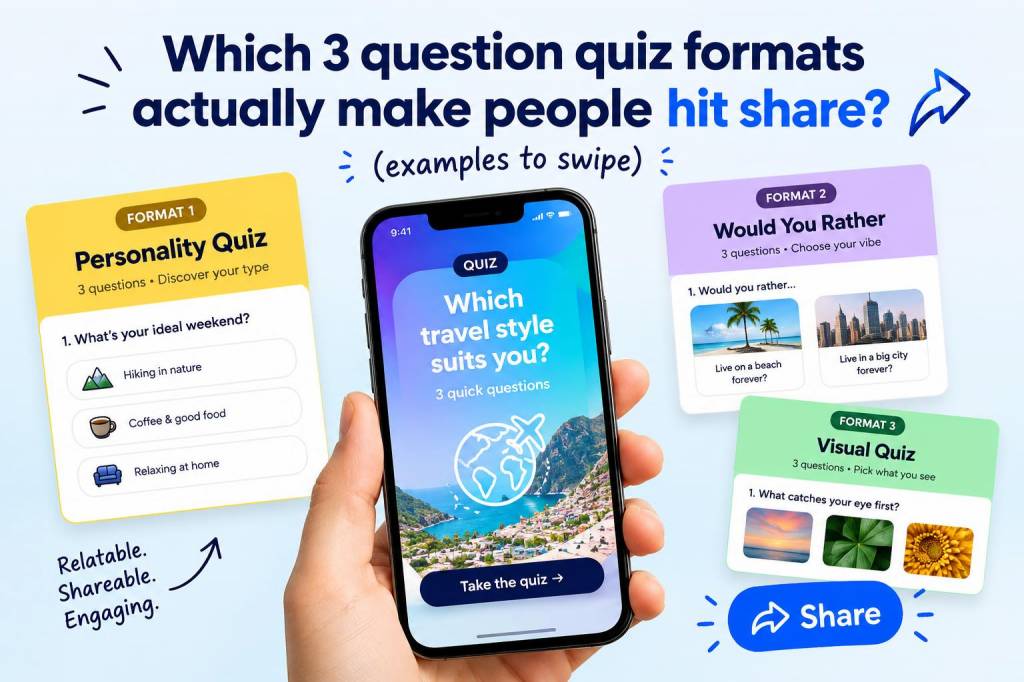
I love a tiny quiz that does a huge job: three fun questions, a surprising result, and — if I did my job — an immediate urge to hit share. Over the years of testing clicky quizzes and scrolling viral lists, I’ve noticed that the most shareable 3‑question formats follow a few predictable patterns. Below I break down which ones actually get people to hit that share button, why they work, and give swipeable examples you can drop into your next post or social story.
Why three questions?
Three questions is a sweet spot. It’s short enough to finish during a coffee break and long enough to feel like a mini-experience. People are far more likely to complete something that feels like it won’t ask too much of their time. And if the payoff is immediate, clever, or flattering, they’ll want to show it off.
Psychology behind the shares
Here are the main emotional drives that make people share a quiz result:
If your 3‑question quiz taps at least one of these emotional triggers, you’re on the right path.
High-performing 3-question quiz formats (and examples to swipe)
Below are formats I keep coming back to. For each I include the structure, why it works, and a swipeable example you can copy, tweak, and publish.
1) “Which [group/era/character] are you?” — Identity with nostalgia
Structure: 3 questions about preferences or small habits + result maps to a beloved group/era/character.
Why it works: People love seeing themselves as a character or part of a tribe, especially when nostalgia is involved.
| Format | Why it works | Swipeable example |
|---|---|---|
| Which 90s sitcom best matches your personality? | Familiar cultural anchors & instant recognition = share-worthy bragging rights | Q1: How do you spend a Saturday afternoon? Results: Friends, Seinfeld, Fresh Prince, or Full House — “Share your 90s sitcom vibe!” |
2) “Guess your [hidden trait] based on three choices” — Insight with surprise
Structure: Three slightly oddball choices that supposedly map to a hidden trait (e.g., emotional intelligence, secret career, dream city).
Why it works: People crave insight. If the result reads as insightful or spooky-accurate, they’ll share to prove the quiz is “so me.”
| Format | Why it works | Swipeable example |
|---|---|---|
| What quiet habit reveals your leadership style? | Perceived accuracy + curiosity = viral bragging | Q1: Morning ritual? Results: Visionary, Delegate, Problem Solver, or Cheerleader — “Tell a friend which leader you are.” |
3) “Pick three things and we’ll tell you your perfect [vacation/room/puppy]” — Personalization + practicality
Structure: Choose three options (style, vibe, activity) → instant tailored recommendation.
Why it works: People love personalized recommendations, and a helpful result is easy to share as a tip or to get opinions.
Q1: Beach or mountains?
Q2: Early bird or night owl?
Q3: Food tour or spa day?
Results: “Your ideal weekend is a coastal town with sunrise walks + a tapas tour. Tag a friend who owes you a weekend!”
4) “Only people who know me will get this” — Social challenge / filter
Structure: Three insider questions (TV references, micro-preferences) designed to be shared among friends.
Why it works: Creates a social loop — people tag friends to prove they know you or to see if someone gets the same result.
- Swipe: Q1: Which meme is your default reaction? Q2: Favorite way to cancel plans? Q3: Your texting speed? Result: “The Soft Ghost / The Gatekeeper / The Over-explainer” — “Tag a friend who’s the Soft Ghost.”
5) “This tiny quiz reveals if you’re more [A] or [B]” — Binary clarity
Structure: Three forced-choice Qs that split people into two big camps.
Why it works: Humans love belonging. Being in a labeled camp is comforting and instantly discussable.
Swipe example:
Q1: Coffee or tea? Q2: Plan or wing it? Q3: Text or call? Result: “Team Planner or Team Spontaneous — Share to declare your side.”
Tools for making your 3-question quiz share-ready
Here are simple production tips I use to turn a good quiz into something people will actually share:
Quick templates to crib from
Copy-paste these into your editor and swap in your own details:
- “Pick a coffee, a weekend plan, and a pet. We’ll tell you which city fits your soul.”
- “Choose three emojis and discover your celebrity soulmate. Tag who you want to swap with.”
- “Which snack, ringtone, and commute style are you? We’ll guess your friendship language.”
Metrics to watch (so you know if your format works)
Once live, track these KPIs:
I’ve seen quiz share rates double simply by changing one line of result copy or adding a tiny GIF. The formats above are repeatable, but the real magic happens when you match voice and visuals to your audience. Make results feel like a badge worth showing off, and you’ve got a tiny viral engine on your hands.