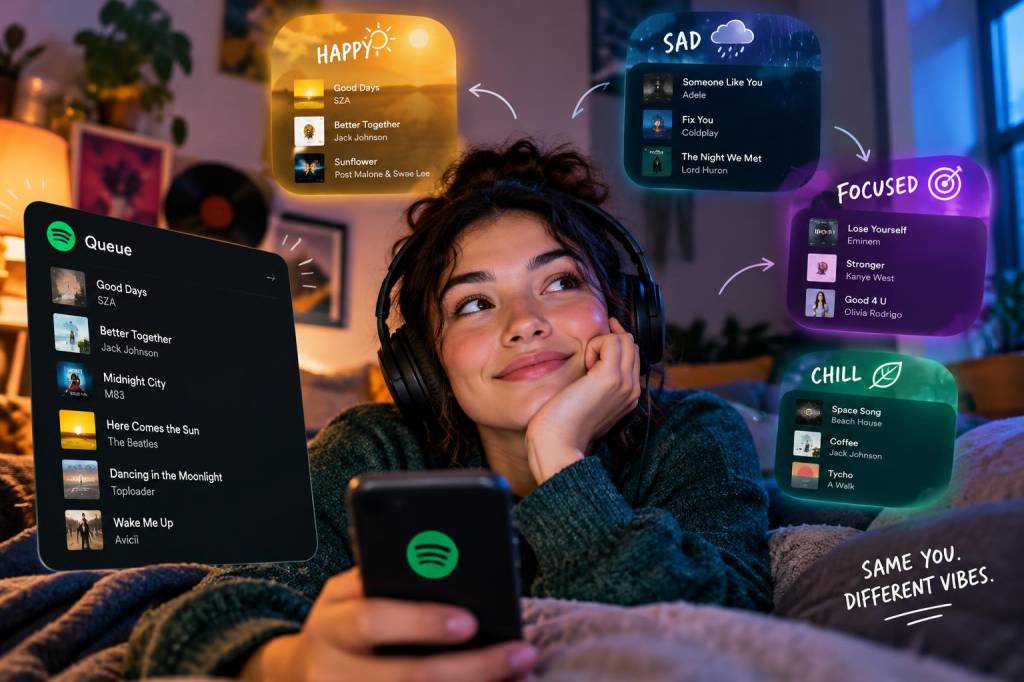
I have noticed something oddly revealing about a perfect Spotify queue: it rarely sounds accidental. A truly satisfying sequence of songs usually says something about what I need, not just what I like. Some days I want momentum, so my queue fills with bright drums, fast hooks, and songs that make me stand up straighter. Other days I want softness, so I keep reaching for warm voices, slower tempos, and tracks that feel like a hand on my shoulder. My playlist changes with me, and because of that, it becomes a small private record of my mood before I have even named it.
What fascinates me most is that a queue is not a static object. It is a moving snapshot. A playlist can be built with intention, but once it starts playing, it begins to reshape itself in response to my energy. If I am restless, I skip toward anything punchy. If I am calm, I stay with longer songs and let them breathe. If I am distracted, I choose familiar tracks because they ask less from me. In that sense, my Spotify queue feels less like a collection and more like a conversation.
What your queue reveals before you realize it
A perfect queue often reflects emotional instinct more than logic. I may tell myself I am simply listening to music, yet my choices usually point to a deeper state. A string of glossy pop songs can mean I want confidence. A row of nostalgic tracks can mean I want comfort. Instrumentals can mean I need mental space. A chaotic mix of genres can mean I am trying to shake off a dull mood and force a reset.
I think many people imagine music taste as a fixed identity, but my queue shows that mood is often stronger than identity. I can love a moody indie song and still reach for an upbeat dance track when I need oxygen. I can adore a singer-songwriter album and still loop a viral anthem when I want a quick emotional lift. The queue is where those layers meet: taste, memory, habit, and current feeling.
It also says something about attention. When I choose a queue carefully, I am usually giving myself a little structure. I am telling my brain what kind of hour is coming. That is why a morning queue feels different from a late-night queue, even if both contain songs I already know. One is about activation. One is about landing. One gets me moving; the other helps me slow down.
Why my playlist keeps changing my mood back
The strange part is that music does not only reflect mood. It can actively alter it. I might start with a certain emotional tone, but after a few songs, I notice my posture, breathing, and focus changing. A good chorus can lift me. A familiar melody can settle me. A propulsive beat can make a boring task feel possible. A dreamy track can stretch time in a good way.
I think this happens because music gives my mind something to synchronize with. Rhythm creates a kind of internal pacing. Lyrics can give shape to feelings I have not fully formed yet. Even production choices matter: a crisp snare can make me feel sharper, while a hazy reverb can make me feel less pinned down. My playlist is not just background noise; it becomes an environment.
Sometimes, though, it changes my mood in a less obvious way. If I begin with songs that match sadness too closely, I can stay there longer than I meant to. If I start with too much intensity, I can become overstimulated. That is why my queue matters. It either reinforces what I already feel or nudges me somewhere else. A smart playlist does both, depending on what I need. It can meet me where I am, then gently move me.
Signs a queue matches your state of mind
When I feel aligned with a playlist, I usually notice a few things at once:
- I stop skipping tracks and let songs play through.
- I start doing whatever I am doing with more focus or more ease.
- I feel less need to check my phone for stimulation.
- I begin singing along or moving without planning to.
- The songs seem to answer my mood instead of fighting it.
When a queue does not match my state, I feel it quickly. I skip too much. I get impatient. I think every song is “almost right” but not quite. That is usually my cue to change direction. I might move from acoustic to electronic, from new releases to old favorites, or from lyrical songs to instrumental ones. The mismatch is useful because it tells me I am trying to force a mood that is not actually mine.
What different queue styles can say
| Queue style | What it often says about mood | What I usually need |
|---|---|---|
| Upbeat pop and dance tracks | I want energy, confidence, or a reset | Movement, sunlight, or a task that needs momentum |
| Soft acoustic songs | I want calm, comfort, or emotional safety | Quiet space and low pressure |
| Nostalgic old favorites | I want familiarity and memory | Something reassuring and easy to trust |
| High-energy rap or electronic music | I want focus, edge, or adrenaline | Action, commuting, or a confidence boost |
| Ambient or instrumental tracks | I want distance from noise | Concentration or mental breathing room |
I do not treat these patterns like rules, because mood is never that neat. Still, I find it helpful to notice what I keep returning to. If my queue starts looking repetitive, it is often because my emotional life has become repetitive too. If it starts getting wildly mixed, I may be trying to cover several feelings at once. Either way, the playlist is telling me something honest.
Why changing the queue can feel like changing myself
I love the small drama of rearranging a playlist because it feels like a tiny act of authorship. I may not be able to change a stressful day instantly, but I can change the sound around it. That matters more than it sounds. Music can make a room feel lighter, a commute feel shorter, or a lonely hour feel companionable. When I edit a queue, I am not just choosing songs. I am choosing a version of the next fifteen minutes.
That is also why my playlist keeps changing me. A sequence of songs can shift my expectations before I even notice. If I start with a gentle track, I become more patient. If I start with something bold, I become more outgoing. If I start with a song I loved years ago, I may become more reflective than I planned. In a real sense, the playlist rehearses a mood for me, and my brain follows along.
I also think changing playlists can be a way of checking in with myself without making a big production out of it. I do not always want to journal or analyze my feelings in detail. Sometimes I just want to hear what my mind reaches for when it is left alone with a search bar and a few minutes of silence. That search history, those saved tracks, those reordered queues—they are all little clues.
What I notice when I let algorithm and instinct work together
Spotify often recommends songs I would have chosen anyway, but the interesting part is when algorithm and instinct start influencing each other. I click one song, and suddenly the next few suggestions sharpen a mood I was already circling. Or I chase a recommendation I would normally ignore, and it opens a completely different emotional lane. I do not think that is random. It is a reminder that taste is not fixed; it is responsive.
My best queues often come from a mix of planning and surrender. I might add a few anchor songs that I know will set the tone, then let the rest drift. That balance keeps the playlist from feeling overly controlled. It gives me enough shape to trust it, but enough openness to surprise me. When that works, I feel almost like I am walking beside my own mood instead of chasing after it.
There are also days when I need the opposite: no curation, no clever sequencing, just one familiar track repeated until my nervous system settles. On those days, a perfect queue is not polished. It is practical. It is the musical equivalent of wearing clothes I already know I like. Comfort matters. Predictability can be a gift.
What I ask myself before pressing play
Before I start a queue, I usually ask a few silent questions:
- Do I want energy or comfort?
- Do I want to match my mood or shift it?
- Do I need focus, release, or distraction?
- Do I want familiar songs or something fresh?
- Will lyrics help me, or will they take up too much space?
Those questions sound simple, but they help me build a queue that feels personal instead of random. They also remind me that mood is not one thing. It can be layered, contradictory, and changeable within a single afternoon. My playlist changes because I do. And because I do, the queue becomes less about perfection and more about timing.
That is what I keep coming back to: a perfect Spotify queue is not necessarily a flawless set of songs. It is a sequence that meets me at the right emotional distance. Sometimes it makes me feel seen. Sometimes it makes me feel braver. Sometimes it makes me feel calmer than I was a minute before. And sometimes it quietly reveals that I was never as certain about my mood as I thought I was.