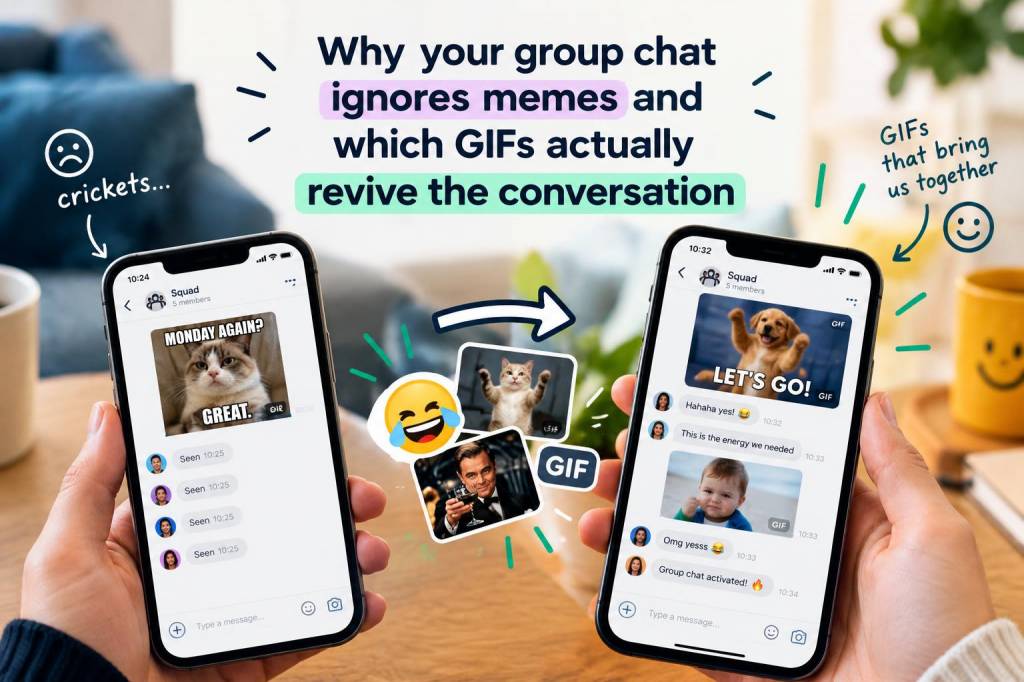
I have lost count of how many times I have dropped what I thought was a perfect meme into a group chat only to watch it sink into silence. Not a single laugh. Not even a lazy emoji. Just that strange blank space where a reaction should have been. If you have ever felt personally betrayed by a group of people you once trusted with your funniest content, I understand you completely.
What I have learned is that group chats do not ignore memes at random. They ignore them for very specific reasons. A meme can be hilarious on its own and still fail in a chat because timing, tone, group mood, and even the format all matter more than we want to admit. I used to assume that funny content could rescue any conversation. Now I know a meme is more like a match: it only works if the room is ready for a spark.
Why a meme lands in one chat and dies in another
The first thing I notice is that group chats have their own personality. My family chat is full of delayed reactions, missed references, and people answering three hours later as if nothing happened. My friends chat, on the other hand, can turn one tiny image into a twenty-message spiral. Same meme, two very different outcomes.
That tells me something important: people do not react only to content. They react to context. A meme can be funny, but if everyone is already tired, busy, or distracted by another thread, it becomes background noise. If a chat has already been active for hours, a meme may feel like an interruption instead of an invitation. And if the joke depends on a very specific reference, half the group may simply not know what they are looking at.
I also think some memes fail because they ask for too much effort. A meme that needs explanation is already halfway to defeat. In a fast-moving chat, people want instant recognition. They want to see it, get it, and move on. If they need to decode it first, they often do not bother.
What usually kills the vibe
Over time, I have noticed a few common meme mistakes that make a conversation stall instead of start moving again.
- Overly niche references: If only one person understands it, the rest of the chat will stay quiet.
- Too much repetition: A meme can stop being funny when it feels copied from every other feed.
- Wrong timing: A joke dropped during serious discussion rarely gets the attention it wants.
- No emotional fit: If everyone is venting, a random absurd meme can feel disconnected.
- Low visual clarity: Small text, cluttered images, or weak resolution make people scroll past.
- Inside-joke overload: If only the sender is laughing, the chat tends to go quiet.
I have also noticed that some people post memes as if they are throwing content into a void and hoping the void does the rest. A meme works better when it feels connected to what is already happening. If your chat is talking about Monday stress, a meme about pretending to work while staring into space has a much better chance than a random joke about dinosaurs in sunglasses. Funny? Maybe. Relevant? Not really.
What GIFs actually revive a conversation
If memes are the opening act, GIFs are often the better rescue tool. A good GIF does not just make people laugh. It adds motion, emotion, and instant response. I reach for GIFs when I want to say, without saying too much, “I am here, I saw that, and I have a feeling about it.”
In my experience, the GIFs that revive a chat fall into a few strong categories. First, there are reaction GIFs that communicate a mood so clearly that no caption is needed. A dramatic side-eye, a shocked pause, a slow nod, a chaotic laugh: these work because everyone immediately understands the feeling. Second, there are expressive looping GIFs that exaggerate everyday reactions. A character collapsing onto a couch, a celebrity doing an over-the-top clap, or a perfectly timed eye roll can restart a stalled conversation because they feel alive.
Then there are GIFs that add rhythm. A meme is static, but a GIF has movement, and movement pulls attention back into the chat. When someone has stopped replying, a well-chosen GIF can feel like a gentle tap on the shoulder. Not aggressive, not needy, just enough to say, “Come back, this thread still has energy.”
The GIFs I rely on when a chat goes quiet
I have a mental shortlist of GIF styles that almost always help. I am not saying they work every time, but they give a chat a much better shot at waking up again.
| GIF style | What it does | When I use it |
|---|---|---|
| Big laugh | Signals that something genuinely landed | After a decent joke that needs support |
| Shocked reaction | Creates instant energy and curiosity | When someone shares surprising news |
| Slow clap | Adds playful approval or sarcasm | When the chat needs a little teasing |
| Eye roll | Communicates shared exhaustion | When everyone is complaining in sync |
| Chaotic celebration | Turns a small moment into a party | When something silly deserves hype |
| Cat or pet reaction | Feels universally cute and low-risk | When I want warmth rather than sharp humor |
The reason these work is simple: they are broad enough to be readable, but specific enough to feel personal. I do not need to explain a GIF that shows pure disbelief or pure joy. It does that job for me.
When a meme works better than a GIF
Even though I love GIFs, I will admit that memes still win in certain moments. A meme works best when the joke needs a full visual setup. If the humor depends on a before-and-after comparison, a text overlay, or a cultural reference that people already know, a meme can land harder than a moving image. Memes can also be stronger when the point is more layered or more absurd.
I use memes when I want to make people stop and read. I use GIFs when I want them to feel something quickly. That difference matters. A meme can trigger a laugh from recognition. A GIF can trigger a laugh from pure reaction. One asks for a beat of attention. The other works almost like a reflex.
That is why I do not treat memes and GIFs as rivals. I treat them as different tools. A meme can start the joke. A GIF can keep the room alive after the joke has already been told.
My personal rule for restarting a dead chat
When a chat goes dead, I do not throw in the biggest, loudest thing I can find. I ask myself three questions first. Is this relevant to what just happened? Will everyone understand it immediately? Does it invite a response instead of ending the exchange?
If I answer yes to all three, I send it. If not, I wait or choose something else. A group chat is fragile in a weird way. Too much energy can overwhelm it. Too little energy disappears. The sweet spot is a post that feels timely, clear, and easy to answer.
My strongest rescue moves are usually not the most elaborate ones. They are often a reaction GIF, a short looping clip, or a meme that names what everyone is already thinking. The magic comes from recognition. People want to feel seen, even in a silly little chat. When a GIF mirrors the exact mood of the room, it can do what a paragraph never will: it makes everyone feel like they are in on the same joke.
Here is the pattern I come back to again and again: if a chat is sleepy, use a GIF with emotion. If a chat is confused, use a meme with clear context. If a chat is tense, use something light and broadly readable. If a chat is already funny, do not try too hard. A small, well-timed reaction often works better than a grand punchline.
One thing I have stopped doing is forcing a meme simply because I found it funny in private. Private funny and group funny are not always the same thing. A meme that makes me laugh alone on my couch may do absolutely nothing in a crowded chat, and that is fine. I would rather send something that fits the moment than something that only entertains me.
I also pay attention to who is active in the chat at that moment. Some people respond better to dry humor. Others love chaos. Some need a gentle nudge; others want a full dramatic performance in GIF form. Once you know the group’s habits, you can choose content that feels less like random posting and more like social timing.
And yes, sometimes the best move is not a meme at all but a reaction GIF that says exactly what everyone is already thinking. That tiny loop of disbelief, delight, or theatrical disappointment can carry more conversational power than a hundred words, especially when a chat has gone from lively to eerily quiet in under a minute.