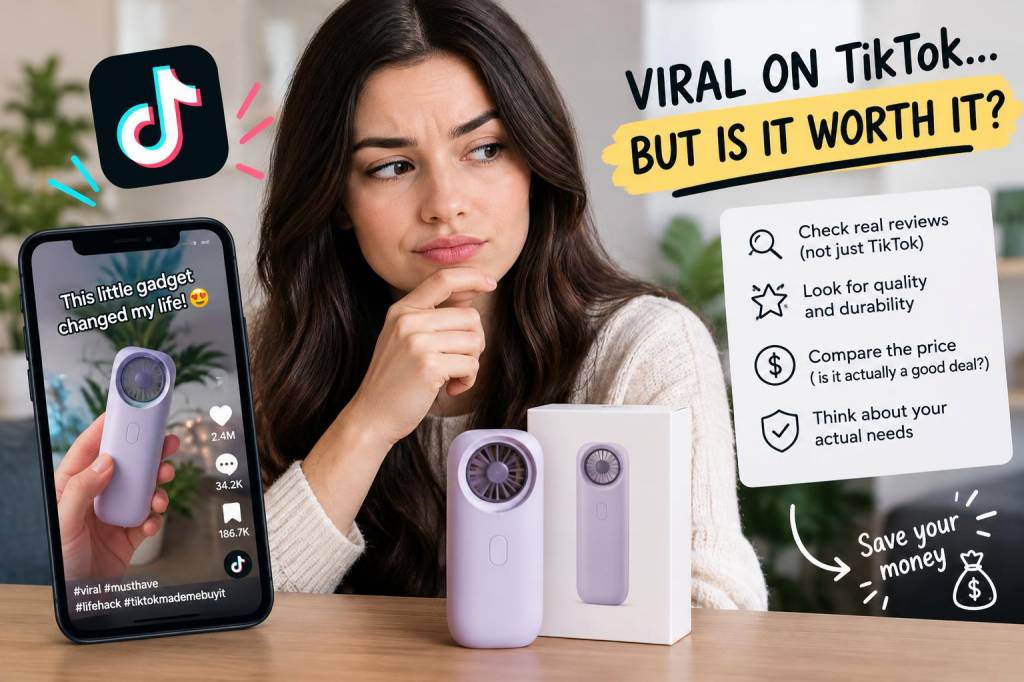
I have watched a lot of viral TikTok products rise fast, sell out faster, and leave a trail of buyers asking the same question a week later: was that actually worth it? I have also made a few impulsive buys myself, which is exactly why I have learned to slow down before clicking “add to cart.” A product can look magical in a 12-second clip and still be flimsy, impractical, overpriced, or totally unnecessary once it arrives at your door.
When I look at a trending item now, I do not ask whether it is popular. Popularity is easy. I ask whether it solves a real problem, whether it will still be useful after the excitement fades, and whether the video is showing me the whole story. That simple shift has saved me from wasting money more than once, and it is the same approach I use whenever a new TikTok obsession takes over my feed.
Start with the problem, not with the hype
The first thing I ask myself is very simple: what problem is this product supposed to solve? Viral videos often skip that part and jump straight to the satisfying part. You see a smooth transformation, a dramatic before-and-after, or a creator smiling at an object as if it changed their life. But if I cannot clearly name the problem, I usually slow down.
A good product should make something easier, faster, cleaner, more comfortable, or more enjoyable. If it does not do at least one of those things in a meaningful way, then I treat it like entertainment, not like a purchase. That mindset helps me separate a clever ad from a genuinely useful item.
I also think about my own routine. A product might be amazing for a college student, a parent, a traveler, or someone who cooks every day, but useless for me. A viral ring light, hair tool, cleaning gadget, or kitchen gadget can be brilliant in one household and pointless in another. Personal fit matters more than a million likes.
Look for signs that a video is selling, not showing
Not every product video is dishonest, but many are carefully staged to make an item look better than it really is. I pay attention to what is missing. If a creator only shows a perfect angle, never mentions a drawback, and somehow every scene looks like an ad, I become skeptical very quickly.
I also watch for editing tricks. Fast cuts can hide weak results, filters can make colors look richer, and close-up shots can make cheap materials look premium. If a product seems unbelievably impressive, I want to see it used in a normal setting, by a normal person, over more than a few seconds.
One of my favorite checks is to see whether the creator demonstrates the product in a real-life mess, not just on a spotless desk or in perfect lighting. Real usefulness often shows up in the imperfect moments: when a tool is dirty, when a bag is full, when a gadget is handled quickly, or when the user has to repeat the action more than once.
Read comments with a healthy amount of doubt
Comments can be helpful, but I never treat them like a final verdict. TikTok comments often split into two camps: people who already bought the item and love showing off their purchase, and people who are guessing based on a short clip. Neither group gives me the full picture by itself.
I look for specific details. A useful comment sounds like, “I bought this and it worked for two weeks before the hinge broke,” or “This is great if you have thick hair, but it pulled on mine.” Those details matter. A vague comment like “OMG need this” tells me almost nothing.
I also search for repeated complaints. If several people mention the same issue, such as weak battery life, cheap packaging, misleading size, or poor customer support, I take that seriously. One complaint could be a bad luck story. Five similar complaints start to look like a pattern.
And yes, I am careful around suspicious praise. When every comment sounds identical, overly polished, or oddly generic, I wonder whether the discussion is as organic as it looks. Real buyers tend to mention specific experiences, not just enthusiasm.
Check whether the price matches the value
Price is where viral products often trick people. Something can feel affordable because it is presented as a tiny impulse buy, yet still be overpriced for what it actually does. I ask myself a brutal but useful question: would I still want this if it were not trending?
Sometimes a product is genuinely useful, but the viral version is marked up for the attention it gets. In that case, I compare similar items from other brands. Often, the trendiest version is not the only option. A regular retailer may sell something nearly identical for less, with better reviews and easier returns.
I also think about cost per use. If I will use a product once and forget it, even a low price may be too much. If I will use it every day for months, a higher price can make sense. Viral items often rely on a low upfront cost to make me ignore the long-term value question, so I force myself to calculate it honestly.
| What I check | Why it matters | My signal |
|---|---|---|
| Problem solved | Tells me if the item has a real purpose | Clear, practical use |
| Video style | Shows whether the clip is informative or just persuasive | Real demo, not just glamour shots |
| Comments | Reveals long-term issues and real experiences | Specific feedback from actual buyers |
| Price | Helps me judge value, not just novelty | Fair compared with alternatives |
| Returns | Reduces risk if the item disappoints | Easy refund or exchange policy |
Search outside TikTok before buying
TikTok is excellent at creating desire and not always excellent at providing context. That is why I almost never rely on TikTok alone. I look for reviews elsewhere: retailer pages, long-form videos, Reddit threads, and blog posts from people who have used the product for more than a few days.
Longer reviews are especially useful because they usually include details that short clips cannot fit. I want to know if the battery lasts, if the material stains, if the size is accurate, if assembly is annoying, or if the product becomes inconvenient after the first week. Those are the questions that decide whether I feel happy or annoyed later.
When I can, I look for comparison content. A product may look impressive on its own, but not when placed next to a cheaper competitor. This is where many viral items lose their charm. The internet can make a small improvement feel revolutionary, but sometimes the difference is tiny.
Trust practical proof more than aesthetic proof
Some products go viral because they look satisfying rather than useful. That does not automatically make them bad, but it does change how I judge them. A pretty organization item, for example, might make a closet look calm on camera while adding extra steps to real daily life. A cleaning gadget may create a dramatic visual payoff while being awkward to store or maintain.
I ask myself whether the product performs well when no one is watching. That means thinking about durability, storage, cleanup, and convenience. If a product only works when everything is perfect, it is probably not built for real life.
I also pay attention to whether the item feels like a novelty or a habit-former. A novelty is fun once. A habit-former earns its place because I keep reaching for it. That difference matters a lot when I am deciding if something is worth the money.
Watch for hidden costs and annoying extras
Some viral products look cheap at first, then become expensive once I notice the extras. Replacement parts, refills, batteries, subscriptions, special cleaners, extra attachments, or fragile components can turn a simple purchase into a hassle. I do not mind paying more if the value is there, but I dislike surprises.
I also think about shipping time and return friction. If the item takes weeks to arrive from an unknown seller, or if returning it looks complicated, that risk is part of the price. A product that seems fun can feel a lot less fun when I realize I may be stuck with it if it disappoints.
Another hidden cost is time. If a gadget takes longer to clean, assemble, or use than the thing it replaces, I usually pass. Convenience should feel like a gain, not a side quest.
Use a simple yes-or-no checklist before checkout
Before I buy a viral TikTok product, I run through a quick mental checklist. If I cannot answer yes to most of these, I wait.
- Do I clearly understand what problem this solves?
- Have I seen it used in a real-life setting?
- Do comments mention specific, believable experiences?
- Have I checked reviews outside TikTok?
- Does the price still feel fair without the hype?
- Would I still want it if no one on my feed was talking about it?
- Is there an easy return option if it disappoints?
- Will I use it enough to justify the cost?
If I hesitate on the last question, that is usually my answer. I have learned that the fastest way to avoid buyer’s remorse is to let a little excitement cool off before I spend money. Viral products are designed to spark instant desire, so I try to create a small delay between seeing the clip and making the purchase.
That pause is often enough to reveal whether I truly want the item or just want the feeling the video gave me. Sometimes I come back later and still want it, which is a good sign. Other times I forget about it entirely, which tells me I probably saved myself from another drawer full of unused stuff.
Know when a viral buy is actually a smart buy
I do not think every trending product is a trap. Some viral items are popular because they are genuinely clever, useful, and well timed. I have bought a few things that earned their place in my home because they solved a specific annoyance better than anything I had before.
The difference is that those purchases survived my scrutiny. They had a clear purpose, decent reviews, fair pricing, and a real chance of fitting into my routine. In other words, they were not just viral. They were practical.
When I see a new TikTok product now, I enjoy the spectacle first and make the purchase decision second. That approach lets me appreciate the internet’s endless stream of shiny objects without letting them empty my wallet.